
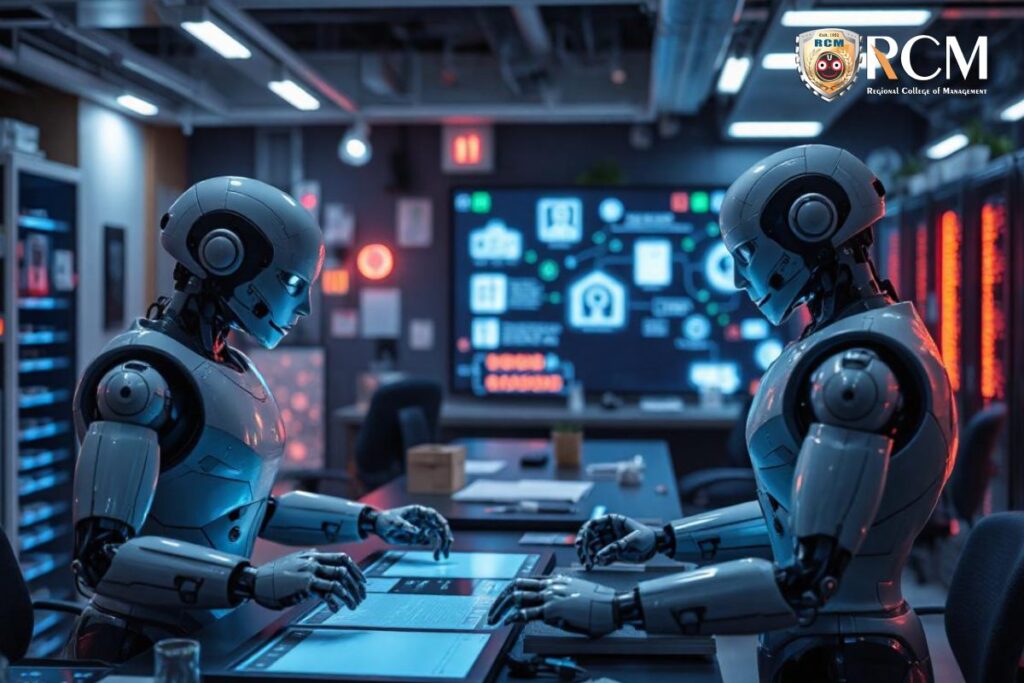
Technology has always been humanity’s most powerful tool — from the invention of the wheel to the internet revolution. But the world is now witnessing something far more transformative: the rise of AI in 2025. Artificial Intelligence is no longer just a buzzword from science fiction; it’s the invisible force driving industries, shaping economies, and redefining what it means to be human in the age of machines.
1. From Experiment to Everyday Reality
A decade ago, AI was limited to research labs and futuristic predictions. But by 2025, it has quietly integrated into our daily routines.
We wake up to voice assistants like Alexa, unlock phones using facial recognition, and rely on algorithms to suggest music, news, and even dating matches.
This silent but steady integration shows that the rise of AI in 2025 is not a sudden revolution — it’s a carefully evolving transformation that’s already become part of our human fabric.
2. AI in Business: Smarter Decisions, Faster Results
For businesses, AI is no longer an optional upgrade — it’s the backbone of modern decision-making.
Companies now use AI to predict consumer behavior, detect fraud, and personalize experiences at a scale humans alone could never achieve.
Retailers analyze millions of data points to understand buying patterns. Banks use AI to assess credit risk within seconds. Healthcare systems rely on algorithms to detect diseases earlier than traditional methods.
In short, the rise of AI in 2025 is helping companies move from reactive to predictive — from guessing what customers want to knowing it before they do.
3. AI and Automation: Redefining the Workforce
The conversation around AI often sparks fear about job loss — and it’s a valid concern. Automation is changing how industries operate, but it’s also creating new opportunities.
By 2025, AI has not just replaced repetitive tasks but has opened doors for entirely new professions — AI trainers, data ethicists, machine learning engineers, and digital strategy analysts.
The real shift lies not in losing jobs but in transforming them. The future workforce will be defined by collaboration between human intuition and machine precision.
That’s the true essence of the rise of AI in 2025 — not replacing humans, but enhancing them.
4. Healthcare Revolution: From Treatment to Prediction
AI’s impact on healthcare in 2025 is profound.
Instead of waiting for illnesses to occur, AI-driven tools can now predict potential health issues through wearable devices and real-time data analysis.
Imagine a smartwatch that alerts you about heart irregularities before symptoms appear or an app that suggests lifestyle changes based on your genetic data.
Hospitals are using AI-powered diagnostic systems that can detect cancer or diabetes at early stages with incredible accuracy.
This proactive approach is saving lives and reshaping the entire medical industry — all thanks to the rise of AI in 2025.
5. Education: Personalized Learning for Every Mind
The education sector has also evolved dramatically. In 2025, AI-powered platforms are helping students learn at their own pace, style, and ability.
AI tutors can now identify where a student struggles and adjust teaching methods accordingly. Schools are using data analytics to improve learning outcomes, while universities are integrating AI-driven career guidance tools.
This personalization ensures that education is no longer one-size-fits-all — it’s tailored to individual potential. And that’s one of the most empowering outcomes of the rise of AI in 2025.
6. Smart Cities and Everyday Living
Our cities are becoming smarter and more connected.
Traffic signals adjust in real-time, reducing congestion. Waste management is optimized using AI sensors. Even law enforcement uses predictive analytics to anticipate crime patterns and improve safety.
By 2025, AI isn’t just a digital tool — it’s the nervous system of modern cities, helping them function more efficiently and sustainably.
The rise of AI in 2025 is leading to urban ecosystems that think, learn, and respond dynamically.
7. Ethics and Responsibility in the Age of AI
While the possibilities seem endless, the rise of AI in 2025 also brings significant ethical challenges. Who owns the data? Can AI make fair decisions? How do we ensure that automation doesn’t widen social inequality?
These questions are now central to public debate.
Governments and tech companies are working to create frameworks that balance innovation with accountability. Transparency, fairness, and privacy are no longer optional — they’re essential to building public trust in AI systems.
The challenge ahead is ensuring that AI serves humanity, not the other way around.
8. AI and Creativity: Machines That Imagine
One of the most fascinating developments in 2025 is AI’s leap into the creative world.
From writing poetry to composing music and designing architecture, AI is now co-creating with humans.
Yet, while algorithms can mimic creativity, they lack intention. They don’t feel joy, sorrow, or ambition — emotions that still belong to us.
The collaboration between human imagination and AI capability is redefining what creativity means. The rise of AI in 2025 is not about machines replacing artists; it’s about amplifying human expression.
9. Global Impact: Bridging or Widening the Gap?
AI has the potential to solve global problems — from climate change prediction to efficient energy use and smart agriculture.
But at the same time, it risks deepening divides between countries that have access to AI and those that don’t.
In 2025, the race for AI dominance has become geopolitical. Nations that invest in AI infrastructure are gaining economic and strategic advantages.
The real test for humanity will be ensuring that the rise of AI in 2025 benefits everyone — not just a select few.
10. The Human Element: Our Most Important Algorithm
As machines grow smarter, the value of human qualities — empathy, ethics, creativity, and emotional intelligence — grows even more.
The truth is, AI can process data, but only humans can give it meaning.
That’s why the rise of AI in 2025 is not the end of humanity’s story — it’s the beginning of a new chapter where technology and compassion must evolve side by side.
Conclusion: Shaping the Future Together
Artificial Intelligence is not something to fear — it’s something to understand, shape, and guide.
The choices we make today will determine whether AI becomes a force for unity or division, progress or chaos.
The future is already here. Don’t just be a spectator — be a participant in shaping it. Learn about AI, adapt your business to it, and most importantly, ensure that human values stay at the heart of technological progress.